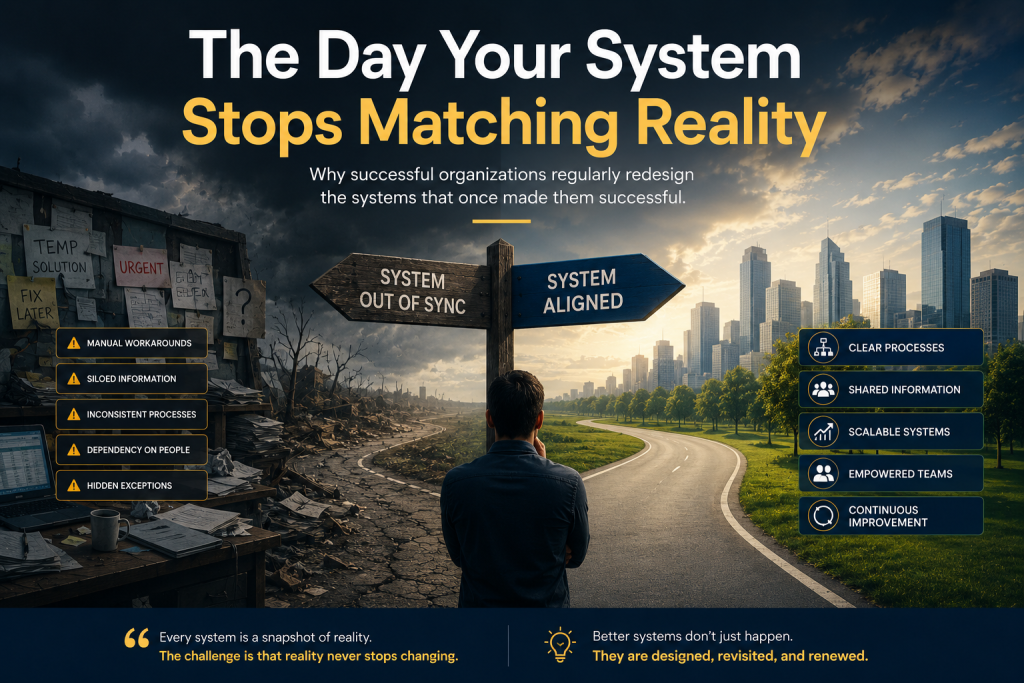
Why successful organizations regularly redesign the systems that once made them successful.
System drift is the reason most business systems don’t fail overnight. They fail slowly.
There is no dramatic moment when everyone agrees the system is broken. Instead, it drifts. A process that once felt effortless becomes slightly slower. A spreadsheet appears to track what the official workflow missed. Someone starts keeping notes outside the system because it’s easier than following the process. An exception gets added to handle a special case. Then another. Then another.
The organization keeps moving. Customers still get served. Work still gets done. From the outside, everything looks normal.
But underneath, something has changed. The system everyone follows is no longer the system that was designed. The system hasn’t failed. Reality has moved, and that gap is what system drift really means.
Every System Is Built for a Particular Reality
Every system is an answer to a specific set of conditions. A startup with five employees doesn’t need the same processes as one with five hundred. A school with a hundred students doesn’t run the way one with ten thousand does. Software serving a few hundred users solves a different problem than software serving millions.
At the moment a system is created, it usually makes sense. The approval process reflects the current team structure. The architecture reflects the current requirements. The reporting workflow reflects the current business model.
The assumptions are reasonable because they match reality at that moment. The problem is that reality never holds still, and the system does. That mismatch, left unaddressed, is exactly how system drift takes hold.
Building Has Never Been Easier — Yet the Problems Persist
For most of history, building things was hard. Software required specialized expertise. Launching products required teams. Automation required real resources.
AI has changed that. People build websites in hours, generate applications in days, produce reports and prototypes faster than ever.
And yet organizations keep struggling with the same problems. Projects still fail. Processes still get inefficient. Teams still get overwhelmed. Customers still get frustrated.
Because building was never the hard part. A company can generate software with AI and still automate the wrong process. A team can deploy a new platform and still be solving the wrong problem. The tools improved. Reality stayed complicated, and system drift kept happening underneath the new tools.
Growth Changes the Shape of the Problem
The most common cause of system drift is growth. A process that works beautifully at one scale often breaks at another.
At ten customers, customer information can live in someone’s memory. At a hundred, a spreadsheet earns its keep. At a thousand, that same spreadsheet becomes a liability. At ten thousand, the whole process needs rebuilding.
The original system wasn’t wrong. It belonged to a different reality — one where the team was smaller, the customer base was simpler, or the technology hadn’t caught up yet. This is why a startup’s first hires expose the limits of informal communication, why a growing school outgrows manual administration, and why a product that gains traction outgrows the architecture it launched with.
The system keeps running. It’s just running on assumptions that stopped being true a while ago.
7 Warning Signs of System Drift
System drift rarely announces itself. It whispers. Here’s what it usually sounds like:
- People start keeping unofficial spreadsheets or notes outside the process.
- New hires take longer than they should to become productive.
- One experienced person has quietly become the process.
- Work needs more follow-ups than it used to.
- Exceptions start outnumbering standard cases.
- Reports need manual correction before anyone trusts them.
- Everyone knows the workaround. Nobody remembers why it exists.
These signs show up so gradually they start to feel normal. That’s what makes system drift dangerous — when inefficiency arrives slowly, it disguises itself as routine.
Technology Can’t Fix a Misunderstanding
When friction shows up, the instinct is to buy new technology. A new platform. A new dashboard. A new automation tool.
Sometimes that helps. Often it doesn’t. Technology executes instructions well. It’s much worse at correcting a misunderstanding. If nobody fully understands how the organization actually operates, the technology just automates the confusion faster, and the system drift underneath goes untouched.
The software works. The dashboard loads. The automation runs. The underlying problem stays exactly where it was, because the system being automated no longer reflects reality.
This is why the most valuable work in technology often happens before any technology gets introduced. Understanding the system matters more than upgrading it. MIT Sloan Management Review makes a similar case for treating organizations as living systems that need continuous learning, not one-time fixes.
The Hidden Cost of Familiarity
System drift is hard to spot because the people closest to it adapt one small step at a time. When a process changes gradually, nobody notices the sum of all the changes.
People learn the workarounds. They memorize the exceptions. They adjust their expectations without realizing it. What feels completely normal on the inside can look strangely complicated to someone seeing it for the first time.
That’s why new employees ask questions veterans stopped asking years ago. Fresh eyes catch what familiarity hides.
Every System Is a Snapshot
The most useful way to think about system drift: every system is a snapshot of reality, capturing what the world looked like the day it was built.
Reality doesn’t stay still after that. Customers evolve. Teams grow. Technology moves. Markets shift. Eventually, every organization hits the moment when the system that created its success starts creating its friction.
That moment isn’t a failure. It’s a sign reality has moved on without the system.
The organizations that last aren’t the ones with flawless systems — those don’t exist. They’re the ones willing to keep asking uncomfortable questions:
- Why do we still do this?
- What problem was this originally built to solve?
- Does that problem still exist?
- If we started from scratch today, would we build it the same way?
Those questions are uncomfortable. They’re also the only way to catch system drift before it becomes expensive.
The greatest risk was never having a bad system. It’s continuing to trust one that no longer reflects the world it was built to serve. If you’re rethinking how your own systems were designed versus how your business actually runs today, Why Digital Transformation Is an Act of Translation, Not Installation is the natural next read.
Key Takeaways
- System drift is the gap between what a system was built for and what an organization has become
- Every system is built for a specific reality
- Reality changes faster than most systems do
- System drift is gradual, not sudden
- Technology can’t solve a misunderstood process
- Growth changes the nature of operational problems
- Organizations that survive keep revisiting their assumptions and catching system drift