
Choosing a backend programming language is one of the first real decisions you make on any serious software project, and it is also one of the easiest to get wrong. Pick based on hype, and you inherit problems you will not feel for months. Pick based on the actual problem in front of you and the team you have, and almost everything after gets easier.
This guide is the conversation I have with founders and engineers before a single line is written. It walks through how to choose the right backend programming language for your project, how to match the language to the type of product you are building, and why security has to be part of the decision from day one, not bolted on at the end.
Key takeaways
- The best backend programming language is the one that fits your problem, your team, and your security needs, not the one trending this month.
- Performance, ecosystem, hiring market, and hosting cost matter more than language “speed” benchmarks for most real projects.
- No language is secure on its own. Security comes from discipline: validating input, controlling access, managing secrets, and patching dependencies.
- Decide before you build. Switching languages later is one of the most expensive mistakes a software team can make.
Table of contents
- What your backend programming language actually decides
- The 7 factors that should drive your choice
- Matching the backend programming language to the project
- Security comes from discipline, not the language
- A simple framework to decide
- Common mistakes when choosing a backend programming language
- Final word
- Frequently asked questions
What your backend programming language actually decides
People treat the language choice like a preference, the way you might pick a favourite text editor. It is not. The backend programming language you choose quietly sets four things for years.
It sets your performance ceiling, because some languages handle thousands of concurrent connections comfortably and others fall over. It sets your hiring pool, because you can only build with the people you can actually find and afford. It sets your security defaults, because every ecosystem has its own common mistakes and its own mature tools for avoiding them. And it sets your cost to run and maintain, from server bills to how quickly a new engineer can become productive.
A language is a long-term commitment dressed up as a quick decision. That is exactly why it deserves more than a glance at a popularity chart.
The 7 factors that should drive your choice
These are the seven questions I weigh, roughly in order, when helping a team pick a backend programming language.
1. Start with the problem, not the trend
The most common mistake is choosing a language because it is fashionable, then bending the problem to fit it. Reverse that. Describe what the system actually has to do first: serve an API, process payments, stream messages in real time, crunch data, or coordinate background jobs. The shape of the problem narrows the field faster than any benchmark.
2. Concurrency and performance needs
Be honest about load. Most products do not need extreme performance on day one, and premature optimisation costs you speed where it matters: shipping. That said, if your product is built around thousands of simultaneous connections, real-time updates, or heavy throughput, concurrency model matters. Go and the Node.js event loop handle large numbers of connections gracefully. Languages like Python or PHP can absolutely scale, but you reach for different tools and patterns to get there.
3. Ecosystem and libraries
A language is only as strong as what surrounds it. A mature ecosystem means battle-tested libraries for the boring, critical things: authentication, payments, queues, validation, and database access. Reinventing those yourself is where bugs and security holes are born. Before you commit, check that the libraries you will lean on are well maintained and widely used.
4. Your team and your hiring market
This is the factor founders underrate the most. The “best” backend programming language on paper is worthless if you cannot find people to build and maintain it. In markets like Nigeria, the talent pool for JavaScript, PHP, and Python is deep and affordable, while specialised languages can mean longer hiring cycles and higher salaries. Build with what your team knows, or what you can realistically hire for.
5. Security track record and defaults
Every ecosystem has a security personality. Some frameworks ship with sensible defaults like CSRF protection, parameterised queries, and safe templating out of the box. Others give you more rope. The language does not make you secure, but a mature framework with secure defaults removes whole categories of mistakes before you make them. Weigh that.
6. Hosting, deployment, and cost
Where will this actually run, and what will it cost? Some stacks deploy almost anywhere cheaply; others assume infrastructure you may not want to manage. Factor in memory footprint, container friendliness, and how much DevOps overhead the stack quietly demands. For lean teams, a language with simple, affordable hosting is worth more than a few percent of raw speed.
7. Long-term maintenance and longevity
Code is read and maintained far more than it is written. Choose a language with a stable release history, strong documentation, and a community that will still be here in five years. Boring and well-supported beats exciting and abandoned every single time.
Matching the backend programming language to the project
There is no universally best language, but there are strong fits for specific problems. Here is how I match the backend programming language to the type of product.
APIs and SaaS backends
For most REST or GraphQL APIs and SaaS products, Node.js, Python, and Go are all excellent. Node.js is fast to build with and shares a language with the frontend. Python is readable and library-rich. Go is compiled, fast, and easy to deploy as a single binary.
Real-time apps, chat, and bots
For chat, live updates, notifications, and messaging bots, Node.js is a natural fit because its event-driven model is built for many concurrent, lightweight connections. This is the stack I reach for when building WhatsApp and Telegram automations.
Data-heavy products and machine learning
If your product centres on data analysis, pipelines, or machine learning, Python is the default for a reason. Its data and ML ecosystem is unmatched, which keeps your backend and your data work in one language.
High-throughput and systems-level services
For services that must handle heavy load with predictable performance, Go and Rust shine. Go trades a little raw speed for simplicity and fast builds. Rust offers exceptional performance and memory safety at the cost of a steeper learning curve.
Business apps and fast CRUD
For content sites, dashboards, marketplaces, and internal tools where speed of delivery matters most, PHP with Laravel, Python with Django, or Ruby on Rails let a small team ship a complete, secure application remarkably fast.
Enterprise and fintech
For large organisations and regulated finance, Java and C# remain dominant thanks to mature tooling, strong typing, and a deep hiring pool of senior engineers.
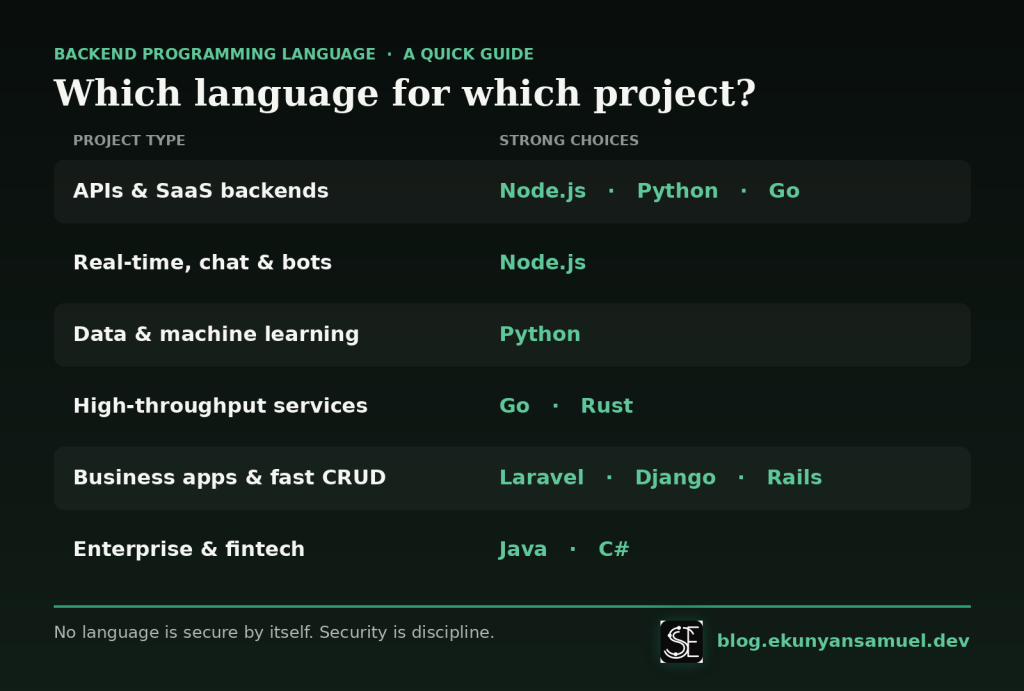
| Project type | Strong choices | Why |
|---|---|---|
| APIs and SaaS backends | Node.js, Python, Go | Fast to build, huge ecosystems, easy hosting |
| Real-time, chat, bots | Node.js | Event-driven, great at many concurrent connections |
| Data and machine learning | Python | Unmatched data and ML libraries |
| High-throughput services | Go, Rust | Performance, predictability, memory safety |
| Business apps and fast CRUD | Laravel (PHP), Django, Rails | Ship complete, secure apps quickly |
| Enterprise and fintech | Java, C# | Mature tooling, strong typing, deep talent pool |
Security comes from discipline, not the language
Here is the part most “which language should I use” articles skip. No backend programming language is secure by itself. A breach almost never happens because someone chose the wrong language. It happens because of decisions made inside the code, regardless of the language.
The most common backend security failures are the same across every stack, and they map closely to the OWASP Top 10:
- Injection. Untrusted input reaches your database or shell. Use parameterised queries and an ORM, never string-built queries.
- Broken access control. A user accesses data that is not theirs. Scope every query to the authenticated owner instead of trusting an ID from the request.
- Broken authentication. Weak sessions, tokens, or password handling. Lean on your framework’s mature auth, not a custom scheme.
- Sensitive data exposure. Secrets in code, stack traces leaking to clients, or data returned that the client never needed. Keep secrets in environment configuration and return only the fields required.
- Vulnerable dependencies. A package you trusted last week ships a published vulnerability this week. Audit and patch regularly.
- Security misconfiguration. Verbose errors in production, default credentials, open ports. Harden your defaults.
Whatever backend programming language you choose, security is a habit you practise on every endpoint, not a feature you switch on once. The discipline travels across languages; the syntax is the only thing that changes.
A simple framework to decide
When a team is stuck, I ask five questions:
- What is the core problem this system solves, in one sentence?
- What does load realistically look like in year one, not year five?
- What do our current people know, and who can we actually hire here?
- Which ecosystem gives us the most secure defaults for this kind of product?
- What will it cost to host and maintain over time?
Answer those honestly and the right backend programming language is usually obvious. The decision stops being about taste and starts being about fit.
Common mistakes when choosing a backend programming language
- Chasing trends. Choosing a language because it is loud on social media rather than right for the problem.
- Optimising for problems you do not have. Designing for millions of users while you are still looking for your first hundred.
- Ignoring the team. Picking a stack nobody on the team knows and nobody nearby can be hired to maintain.
- Treating security as a later phase. Bolting on protection after launch instead of building with secure defaults from the start.
- Rewriting too early. Abandoning a working stack for a trendier one before the current one has actually failed you.
Final word
The right backend programming language is not the fastest, the newest, or the one with the loudest community. It is the one that fits the problem in front of you, the team you have, and the security your users deserve. Get that decision right and the build gets quieter. Get it wrong and you spend the next year fighting a choice you made in an afternoon.
Decide before you build. If you want a second opinion on the stack for a specific project, that is exactly the kind of conversation I am happy to have. Reach me at samuel@ekunyansamuel.dev or visit ekunyansamuel.dev.
Further reading on this blog: the complete guide to WhatsApp business bots in Nigeria and the hidden cost of building a website without a strategy.
Frequently asked questions
Which backend programming language is best for beginners? Python and JavaScript (Node.js) are the friendliest starting points. Both are readable, have huge communities, and offer plenty of tutorials and jobs, which makes the learning curve gentler.
Is Node.js good for backend development? Yes. Node.js is an excellent backend choice, especially for APIs, real-time apps, and bots, because its event-driven model handles many concurrent connections efficiently and it shares a language with the frontend.
Which backend programming language is the most secure? None is inherently the most secure. Security depends on the practices in your code and the maturity of your framework’s defaults, not the language itself. Disciplined input validation, access control, and dependency management matter far more than the choice of language.
Should I use the same language for frontend and backend? You can. Using JavaScript or TypeScript across both with Node.js reduces context switching and lets a small team share code. It is a convenience, though, not a rule, and many strong products mix languages deliberately.
Does the programming language affect my application’s security? Indirectly. The language and framework set your defaults and the kinds of mistakes that are easy to make, but most vulnerabilities come from how the code is written, not which language wrote it.