Most people think valuable digital skills have a software name attached to them.
They’re wrong.
If your entire career moat is built on being the world’s best user of a specific SaaS platform, your professional value has an expiration date. Software changes every few years. Platforms get acquired, features get automated, and algorithms shift.
The people who remain quietly indispensable, the ones who command the highest consulting fees, survive corporate restructuring, and lead the most innovative tech teams, aren’t tracking fleeting tool trends. They focus on the underlying mental models that compound for decades.
They don’t just know the tools; they master the transferable abilities that make the tools work. Here are the 7 quiet digital skills that will make you invaluable in the modern economy.
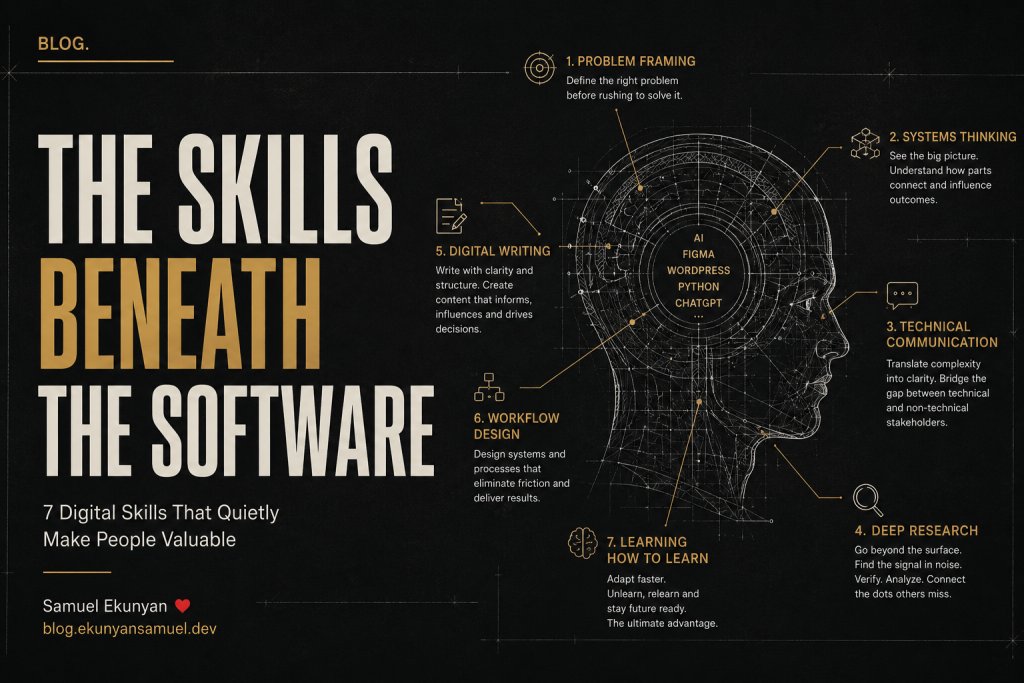
1. Problem Framing (The Art of Finding the Right Question)
Most professionals are eager to solve problems, but very few stop to ask if they are solving the right problem. The highest-paid digital strategists spend significantly more time defining a bottleneck than fixing it.
The Chatbot Fallacy: A non-technical stakeholder approaches a development team and says, “We need to build an AI chatbot for our landing page immediately.”
A novice builder immediately starts looking up API documentation. An expert frames the problem:
- The Request: Build a chatbot.
- The Core Pain Point: Slow customer support response times during off-hours.
- The Real Solution: Optimizing the existing documentation architecture or setting up a simple automated email triage system.
When you master problem framing, you save organizations hundreds of thousands of dollars in wasted engineering hours. You cease to be a mere order-taker and become a strategic asset.
2. Systems Thinking (Moving from Tasks to Architectures)
The digital landscape is not a collection of isolated tasks; it is an interconnected web of dependencies. Beginners look at a project and see a checklist of isolated actions. Experts look at a project and see a living ecosystem.
[Action A] --------> Affects --------> [Database B]
    |                                      |
    v                                      v
Triggers Event C                      Alters Metric D
If you modify a single endpoint in an API, how does it cascade down to the frontend UI, the marketing attribution data, or the customer checkout experience?
Systems thinking separates the “button-clickers” from the actual architects. When you understand how different components affect each other, you don’t just build things that work—you build things that don’t break when the environment scales.
3. Technical Communication (The Multiplier Metric)
You can write the most elegant, highly optimized code or build the most complex data pipeline in the world, but if you cannot explain its business impact to a non-technical stakeholder, its corporate value is effectively zero.
Technical communication is a force multiplier for every other hard skill you possess.
- Poor Communication: “We refactored the legacy codebase using a decoupled asynchronous architecture to mitigate latency spikes.” (The client’s eyes glaze over).
- High-Value Communication: “We upgraded the backend system so the app loads three times faster for users on slow mobile connections, which will prevent them from abandoning their shopping carts.” (The client approves the budget).
Translating complexity into absolute simplicity is a rare, quiet superpower that positions you as the vital bridge between execution and leadership.
4. Deep Research (Beyond the First Page of Search Results)
In an era saturated with generative AI, basic information retrieval has lost its premium value. Anyone can type a prompt or read a superficial top-ten list. True digital research, however, is an elite skill.
+-------------------------------------------------------------+
|                     THE RESEARCH PYRAMID                    |
+-------------------------------------------------------------+
|   LEVEL 3: Synthesis & First-Principles Deduction (Elite)   |
|   -------------------------------------------------------   |
|   LEVEL 2: Sourcing Technical Docs, Whitepapers & Logs      |
|   -------------------------------------------------------   |
|   LEVEL 1: Surface-Level Search Engines & AI Prompts        |
+-------------------------------------------------------------+
True research means:
- Verifying information back to first principles.
- Reading raw documentation and technical whitepapers rather than relying on secondary summaries.
- Evaluating the bias, authority, and health of a source or codebase.
- Connecting disparate data points to predict where an industry bottleneck will happen next.
AI makes surface-level data cheap, which makes deep, analytical research incredibly expensive and highly sought after.
5. High-Impact Digital Writing (The Executive Currency)
Every digital interaction you have leaves a text trail. Your emails, documentation, code comments, project proposals, Slack updates, and technical reports are the mirrors through which your competence is judged.
Many brilliant tech careers stall not because of poor technical execution, but because of poor writing quality. High-impact digital writing is clear, concise, and structured for quick scanning. It respects the reader’s time by getting straight to the point, outlining the choices, and defining explicit next steps.
If your writing is chaotic, people will assume your thinking is chaotic. If your writing is sharp, organized, and persuasive, your career velocity will follow suit.
6. Workflow Design (Selling Outcomes, Not Orchestration)
Businesses do not write checks for software licenses; they buy predictable, profitable outcomes. A tool is entirely useless without an optimized operational framework to guide it.
| Persona | Focus | Perspective |
| The Amateur | The Tool | “Look at this incredible automated web scraping framework I found.” |
| The Expert | The Workflow | “Here is a 3-step pipeline that automatically extracts user feedback, flags critical bugs for the dev team, and updates our product roadmap without human intervention.” |
The value lies completely in the orchestration. When you design seamless workflows that eliminate friction, reduce human error, and save time, you transform technology from an expensive line item into a high-leverage engine.
7. Learning How to Learn (The Meta-Skill)
This is the foundational skill that underpins everything else on this list. The tech stacks, frameworks, and programming paradigms that dominate today will inevitably become historical footnotes tomorrow.
The most valuable professionals in the room aren’t those who have memorized a static library of knowledge. They are the ones who can dive into a brand-new, poorly documented codebase, extract the core patterns, and become proficient in it within a weekend.
[New Tech Emerges] ➔ [Isolate Core Patterns] ➔ [Map to Known Systems] ➔ [Rapid Execution]
When you stop fearing technological change and instead master the meta-process of rapid skill acquisition, you become completely future-proof. You don’t panic when an industry shifts—you simply pivot your focus and compound your value.
The Indispensable Professional
The next time you feel the urge to add another software badge to your LinkedIn profile, pause and take an inventory of these seven underlying pillars.
Tools will always come and go. But if you can frame a messy problem, think in broad systems, communicate clearly, research deeply, write persuasively, build efficient workflows, and adapt on the fly, you will never have to worry about staying relevant. You will simply be too valuable to ignore.