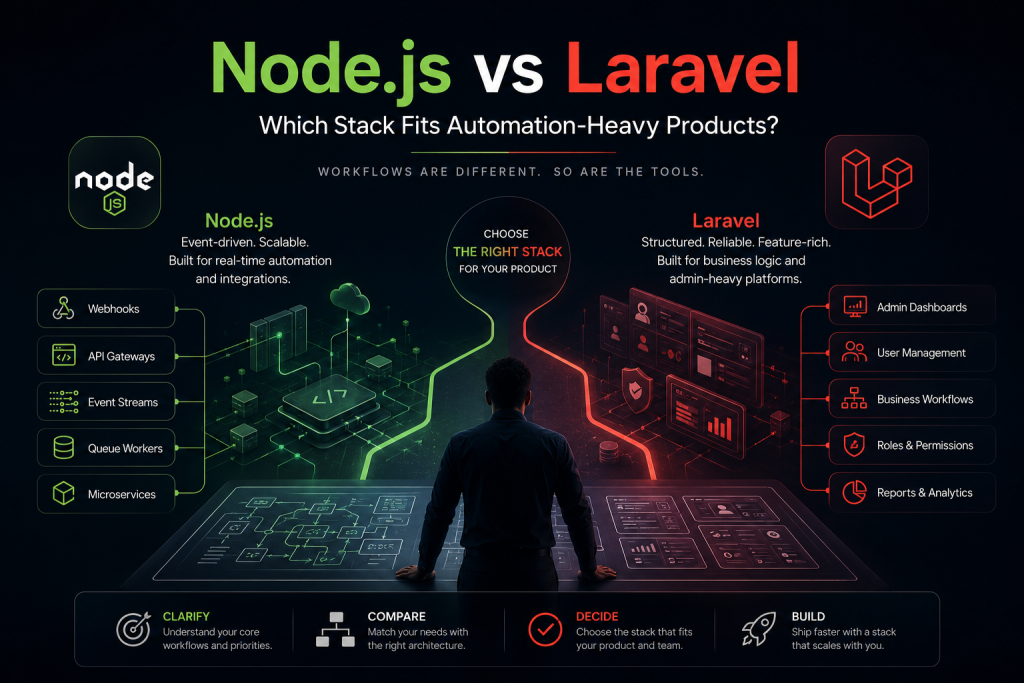
node js vs laravel is the question founders ask me most when they plan automation backends, webhook systems, or API-heavy products. They want a clear answer. There is no universal winner. There is a better fit for your workflow, your team skills, and what you can maintain after launch.
I build with both stacks in production. Node.js for event-driven intake, queues, and integrations. Laravel for admin workflows, roles, and business rules that grow over time. This post is how I decide in real client work, not a framework popularity contest.

node js vs laravel: Start With Workflow, Not Hype
Before you compare runtimes, write what your product does in plain language. Does it mostly react to events (payments, webhooks, chat events, queue jobs)? Or does it mostly manage records (users, orders, approvals, reports, roles)?
Event-heavy products need a different shape than admin-heavy products. Get that wrong and you will fight your stack for months.
I have seen teams pick Node because it is trendy, then lose weeks building admin panels Laravel would ship faster. I have also seen Laravel struggle when the core load was heavy webhook traffic with tight response windows. The issue was workload mismatch, not language quality.
node js vs laravel: When Node.js Wins

Webhook and queue workloads. If your system reacts to incoming events, Node.js is a natural fit. The async model matches real automation behavior.
API-first delivery with small teams. One language across services, fast iteration, and broad integration libraries help you ship intake APIs and workers quickly.
Integration-heavy roadmaps. Multiple third-party services and service boundaries are easier to evolve without forcing a rigid monolith on day one.
Most of my automation backends start in Node.js for this reason. Not because Laravel cannot do it, but because event-first products usually move faster in Node for v1 production.
node js vs laravel: When Laravel Wins

Admin panels and internal tools. Roles, permissions, CRUD, reporting, and audit trails are strong in Laravel from day one.
Growing business logic. If pricing tiers, approvals, and policy rules keep expanding, Laravel structure reduces long-term chaos.
Teams that already ship PHP well. A strong Laravel team beats a weak Node rewrite every time. Skill beats hype.
For platforms where staff log in daily to manage operations, Laravel is often the smarter call in a node js vs laravel review.
node js vs laravel Decision Checklist
Ask these four questions before you commit:
- Is the core workload event-driven or dashboard-driven?
- How many third-party integrations are in v1?
- Who maintains production issues at night?
- What does your team already know well?
If events and integrations dominate, lean Node. If admin logic and reporting dominate, lean Laravel. If your team strongly prefers one stack, that can decide it when workload fit is close.

Common node js vs laravel Mistakes to Avoid
Choosing stack before scoping. Map workflows first, then compare stacks.
Rewriting too early. Many failures are architecture issues: missing queues, weak monitoring, unclear service boundaries.
Ignoring maintenance ownership. The best stack is the one your team can support after launch week ends.
Need a Second Opinion?
I help teams make and implement node js vs laravel decisions for real products: automation backends, APIs, admin systems, and integrations. If you are stuck between stacks, send your product type, team skills, and daily traffic pattern.
Read more on blog.ekunyansamuel.dev or message me on WhatsApp: https://wa.me/2348036375292.
One question
What are you building, and which side of node js vs laravel are you leaning toward right now?